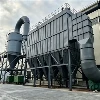
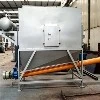
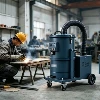
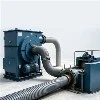
The centrifugal dust collector (also known as centrifugal dust removal equipment) is a device commonly used in industrial settings, primarily for smoke and dust removal in small coal-fired boilers and as a pre-separation stage in multi-stage dust removal systems.
Its operating principle relies on centrifugal force generated by a high-speed rotating airflow to separate dust. Upon entering the device, dust-laden gas undergoes a continuous rotational motion driven by the combined action of a flow deflector and a secondary air swirl; this subjects dust particles to centrifugal force, separating them and directing them into a dust hopper. Compared to inertial dust collectors, this device achieves higher airflow rotation speeds and longer rotation durations-generating centrifugal forces ranging from 5 to 2,500 times that of gravity-thereby enabling the capture of finer dust particles.
Featuring a design with no moving parts, the equipment offers advantages such as ease of maintenance, high-temperature resistance (up to 1,000°C when constructed from special materials), dry dust removal capabilities, and corrosion resistance, making it suitable for various industrial flue gas purification applications. However, it has limitations, including relatively high pressure loss (up to 1,500 Pa for high-efficiency models) and lower removal efficiency for fine dust particles smaller than 5 μm.